
Cruise port
Mâcon on the Saône: Riverfront, Old Town and Heritage
The Saône waterfront, Pont Saint-Laurent, Lamartine and Mâcon’s historic sights.
Mâcon and the Saône
The Saône has shaped Mâcon’s history and waterfront. The river was already used for navigation in Celtic times; the Quai Lamartine has been described as a riverside promenade since 1761. Floods are also part of the river’s history: in 1840, the Saône reached 8.05 metres near the bridge. The waterfront brings the city’s history together with its river landscape.
Pont Saint-Laurent
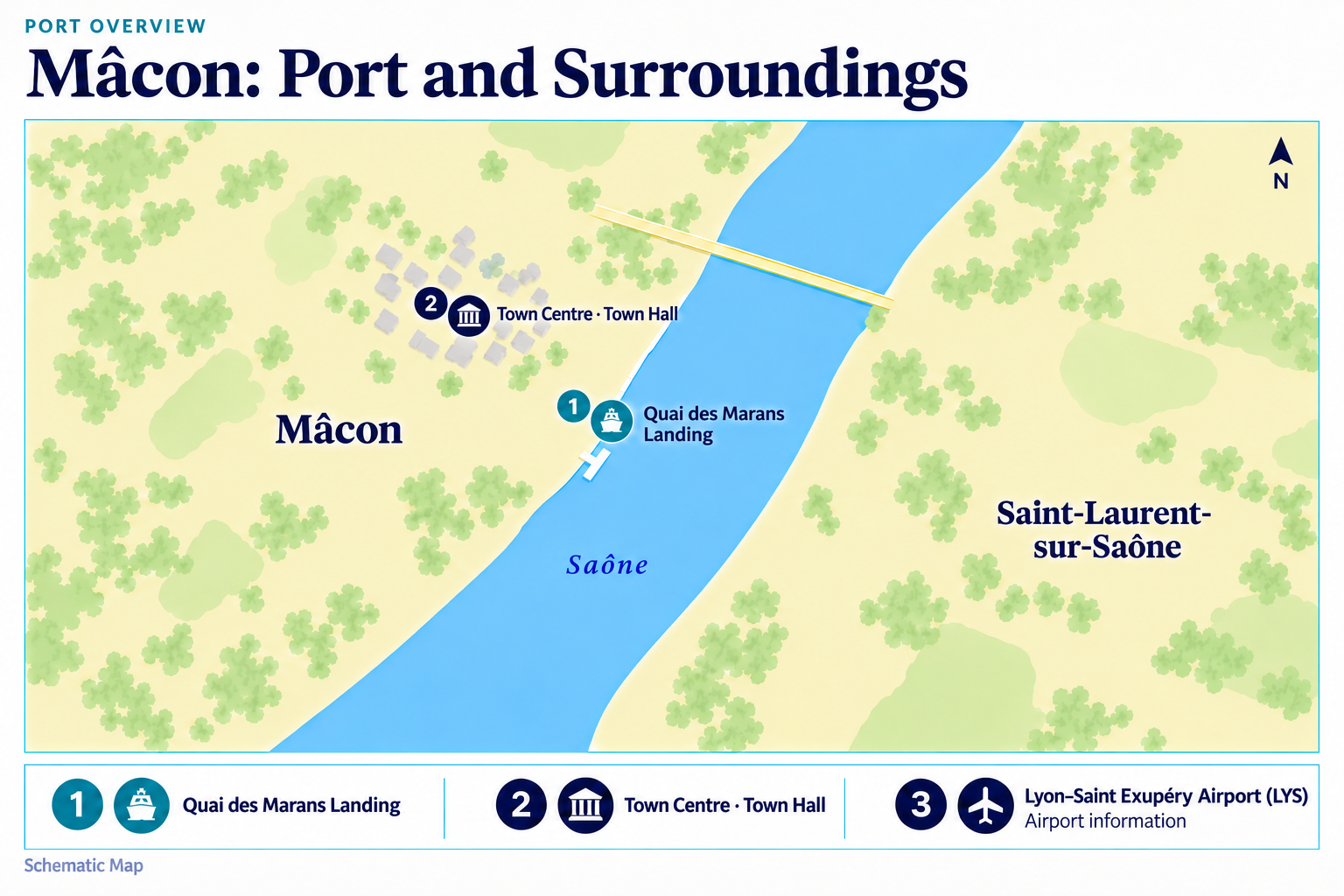
Pont Saint-Laurent connects Mâcon across the Saône with Saint-Laurent-sur-Saône. A wooden bridge stood here as early as Roman times; a stone bridge with six arches was built in the 11th century and fortified in 1221. Later construction work continued until around 1550. Today, the bridge has twelve arches. It survived the Second World War and has retained its appearance ever since. This crossing of the river thus tells the story of changing needs for connection, fortification and urban traffic.
Old Town and Tracé de la Plume
The official “Tracé de la Plume” is a circular route leading to 28 sights and bringing together architecture, literature, gastronomy and local history. The walk takes one to two hours; bronze feathers set into the ground point the way from one monument to the next. The name recalls Alphonse de Lamartine, the poet and politician born in Mâcon. His statue, created by Alexandre Falguière, stands by the Saône: it was unveiled in 1878 and faces the river. The walk thus offers a chance to experience the riverside and the city’s literary history side by side.
Hôtel Montrevel and Maison de Bois
The Hôtel Montrevel has served as the town hall since 1792. The central section of the building dates from 1750; in 1767, its owner at the time had two side wings added, with further wings added in 1880. Inside, historic wood panelling, medallion portraits and a wrought-iron staircase preserve traces of its former life as a residence. The Maison de Bois on Place aux Herbes offers a very different impression. Built between 1490 and 1510, it is considered probably the oldest house in the city. Its wooden façade is carved with figures, masks and fantastical animals.
Église Saint-Pierre
Église Saint-Pierre was built in the 1860s to designs by Berthier, a student of Viollet-le-Duc. It combines Romanesque Revival and Gothic Revival forms. Three portals with stone reliefs divide the façade, above which rise two bell towers. Inside, the choir organ by Aristide Cavaillé-Coll, dating from 1866, is one of the highlights.
Musée des Ursulines
The Musée des Ursulines is housed in a former 17th-century convent. Its collections range from archaeological finds tracing the history of the area back to Celtic times to 20th-century art. A dedicated section explores Lamartine’s literary and political work; he was born in Mâcon in 1790. Other rooms display 19th-century landscape paintings from the region. For more stops on a river journey, see Lyon and Avignon; the river cruise overview provides an introduction to the destinations and ports of call.
Mâcon — Port and Surroundings
 Enlarge map ↗

