
Cruise port
Civitavecchia cruise port: visit the town or take an excursion to Rome
Discover the fortress and old town in Civitavecchia or travel to Rome: plan your shore visit and the journeys between ship, port and city.

Photo: Dago Wiedamann
For many cruise passengers, Civitavecchia is the port for an excursion to Rome. The capital does not lie right beside the quay: planning a shore visit means allowing time to get from the ship ashore and continue the journey. On a Western Mediterranean itinerary, Civitavecchia can be the port of call for a visit to the capital. Those who have already seen Rome or would prefer a more relaxed day can also find a worthwhile destination in the port town itself. The Renaissance fortress of Forte Michelangelo and the old town give the visit a historical focus.
Civitavecchia as a port for Rome
At a port of call, there are two distinct options for a shore visit: a longer excursion to the capital or a stay in Civitavecchia. For Rome, the time available in port should cover the journey there and back as well as the visit itself. In the capital, it is worth choosing one main focus rather than trying to fit several widely separated sights into a single day. Those who stay in Civitavecchia can concentrate on the port area and historic centre. Civitavecchia lies on Italy’s west coast; the Adriatic ports are on the opposite side of the peninsula.
From the ship to shore and back
The port grounds and the routes to the respective exit lie between the ship and the public streets; the specific arrangements depend on the berth and the day of travel. For a cruise-line excursion, the schedule follows the details provided for the tour booked. If travelling independently, remember to allow for walking and waiting times before and after the excursion itself. The ship’s stated return time is a fixed deadline, so it is sensible to leave a buffer for the journey back. For port calls, the arrival, the journey into the town centre and the return to the berth all need to be included in the schedule.
From ancient harbour to Renaissance fortress
The port and the city have a long history. The city administration links Civitavecchia to the Roman Emperor Trajan and describes its subsequent decline after the end of the Roman Empire. In the Middle Ages, a castle was built on the ruins, and a small settlement grew up around it along the old Roman road. After the Council of Constance (1414–1418), the city was reorganised and the port restored. The discovery of alum in the Tolfa Mountains once again made the port an important export centre.
Forte Michelangelo was built to protect this port. Pope Julius II commissioned its construction in 1508 and entrusted the design to Donato Bramante. After Bramante’s death in 1514, Antonio da Sangallo the Younger continued the work and modified the fortifications. The city administration gives 1537 as the year of completion under Pope Paul III, although work on the complex continued in 1538 and 1539. According to the city administration, the commonly held association of the name with Michelangelo is local tradition, while the history of the construction involves several architects. The fortress therefore tells the story not of a single artist, but of a defensive structure built over several decades.
The complex stands on an extensive Roman structure. Its ground plan is quadrilateral, with four large corner towers and an octagonal keep. The fortress was heavily bombed during the Second World War, and the main tower was badly damaged. Today, it still defines the harbour basin and brings together the town’s Roman, medieval and papal history.
Visiting Forte Michelangelo and the old town
Those who stay in Civitavecchia can combine a visit to the fortress with a walk through the historic centre. The city’s visitor information lists the address of Forte Michelangelo as Calata Cesare Laurenti 5 and limits access to the inner courtyard; guided tours are available only on certain days. The visiting hours listed there are marked as updated on 2 January 2025, so they are a dated snapshot. The fortress makes a good starting point for a walk around town: from the harbour promenade, continue into the old town, whose squares and lanes offer a different view of Civitavecchia from a day spent purely in transit.
Civitavecchia Port Map
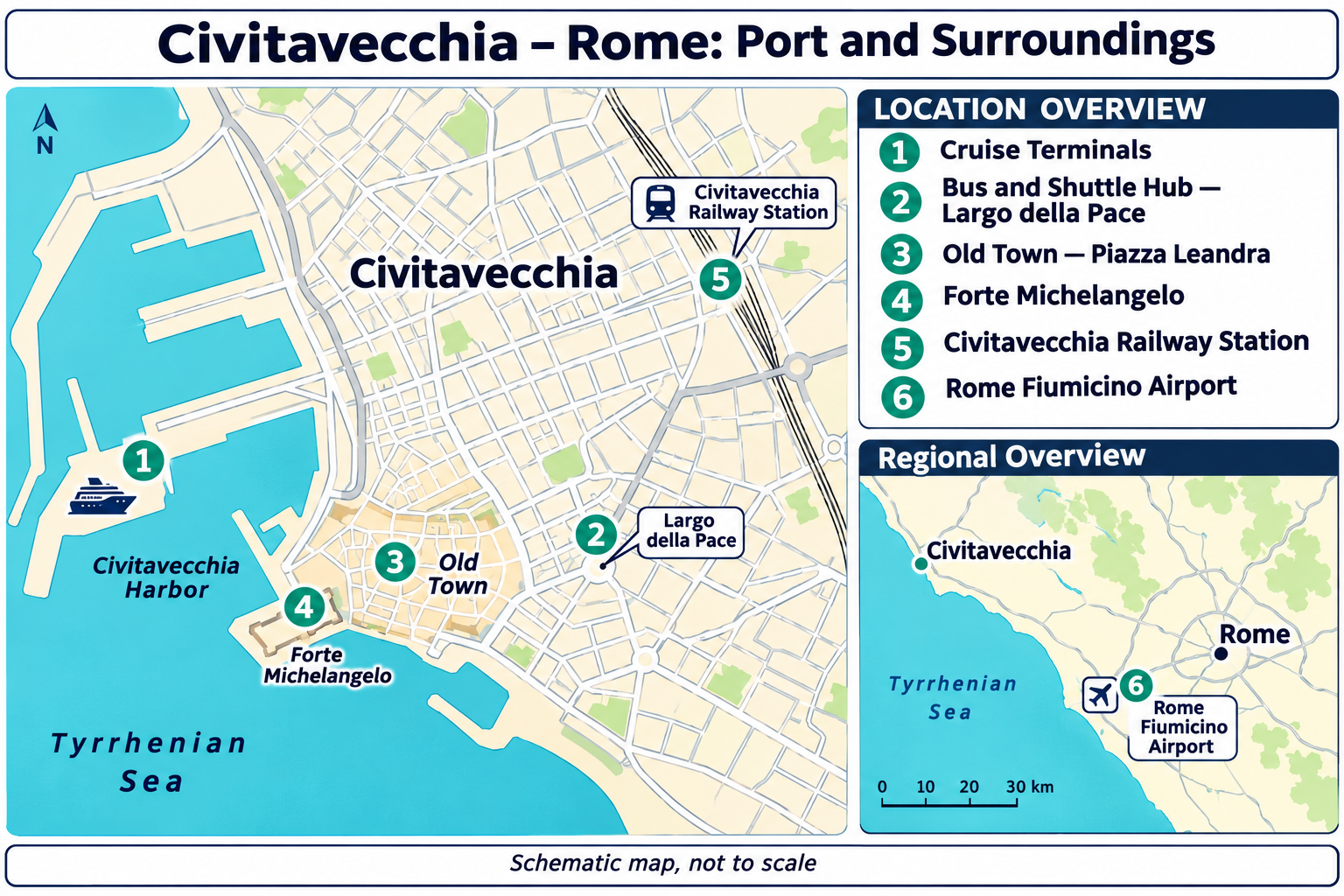 Enlarge map ↗
On shore
Excursions around Civitavecchia - Rome
Rome - classical city
Insight into life in Ancient Rome, and tour. Route: the Coliseum (grand amphitheatre with a capacity for up to 80,000 spectators), the Arch of Constantine, the Forum Romanum and the Capitol. The tour guide will talk about political, religious and public life in Ancient Rome. Lunch. The tour continues with a visit to St. Peter's with its famous dome designed by Michelangelo.
Roma frei geniessen
Visit to the cultural capital of Italy under one's own steam. On the way to Rome a local guide will give information and hand out maps of the city.
Ostia Antica
Guided tour of the Roman port city, built in 827 A.D. by Gregory IV. Insights into the urban planning and organisation of public and private life in the ancient city. Visit to the Neptune baths with their beautiful mosaics, the amphitheatre, the temple of Rome and Augustus, the Jupiter Forum and the Capitolium temple.
Etruscan landscape
Visit to the majestic renaissance site of Madonna della Quercia and the gardens of the Villa Lante, built in 1578. Visit to the medieval village of Tuscania, parts of which date back to the 9th century B.C. Lunch at Lake Bolsena with Tuscan specialities.
Rome - baroque city
Discover the world capital city of Rome on foot: Piazza di Spagna, romantic 19th century location for trysts, the baroque fountain Fontana di Trevi, into which it is traditional to throw a coin in order to guarantee that you will one day return to Rome. Then onwards to the Roman Pantheon (Greek for "all the gods"), built by Agrippa. After lunch a visit to the 17th century Piazza Navona, before continuing on to St. Peter's Square. Visit to the world-famous basilica of St. Peter with its dome designed by Michelangelo.

