
Cruise port
Nagasaki: Cruise port at the heart of a natural bay
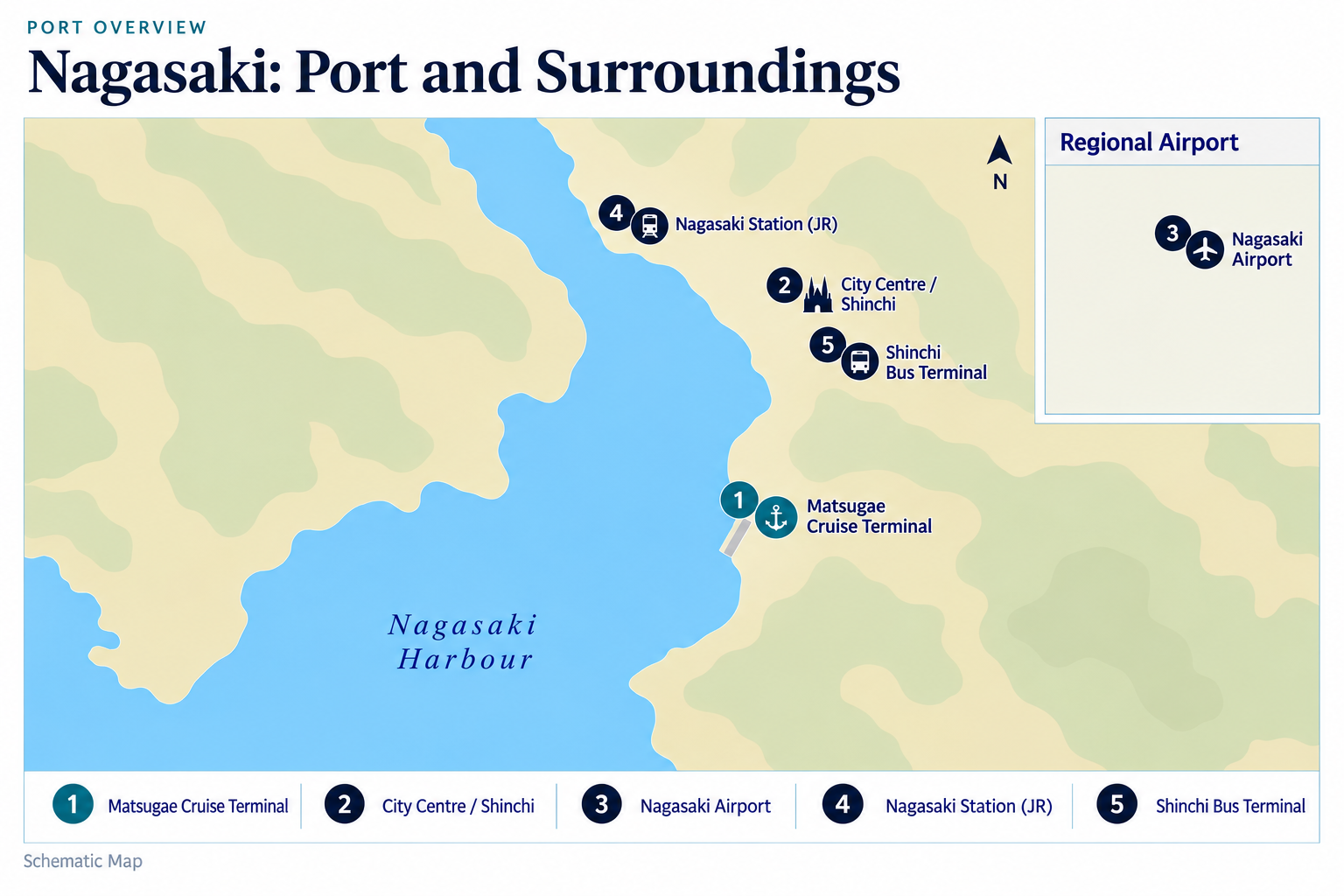
Matsugae International Terminal in the bay, with the city center, Dejima, JR Station, tram, Shinchi Bus Terminal, and Nagasaki Airport.
Nagasaki’s cruise port is located in a natural bay in Japan, surrounded by mountains on three sides. Cruise ships pass beneath the Venus Wing Bridge to the facilities in the city center. The port includes Matsugae Wharf and the Nagasaki International Cruise Ship Terminal in Matsugae-machi. Matsugae and Dejima are the two listed berths.
Matsugae and the city center
The city center is one kilometer from the pier; the tram ride takes five minutes, as of January 1, 2026. Glover Garden is 300 meters away, a five-minute walk. The terminal is at the southern end of the bay; Hamanomachi and Shinchi lie to the northeast.
Dejima and Nagasaki’s port history
Dejima was created in 1636 as an artificial island for Portuguese residents. In 1641, the Dutch East India Company moved its trading post there from Hirado. The Dutch trading post closed in 1859. During this period, Dejima was Japan’s only open window to Europe. A bridge connected the island to the city from 1678; warehouses were built in 1696, and a sea gate was added in 1699.
Ōura Church and cultural exchange
Ōura Church was built in 1864 for the foreign community of the settlement on the hillside above the bay. Nagasaki had opened as a treaty port five years earlier, in 1859. Its original wooden structure was enlarged in 1879 with a white-plastered brick building. The design combines an octagonal tower and pointed stained-glass windows with wooden rib vaults; bamboo and clay were also used in the ceiling construction. The design was created by French priests Furet and Petitjean, with the help of Koyama Hidenoshin, a Japanese master builder from Amakusa. In 1865, hidden Christians from Urakami made contact with Petitjean. Since 2018, Ōura Church has been part of the UNESCO Sites of the Hidden Christian Sites in the Nagasaki Region. Restoration was completed in 1952 after the war damaged the roof, ceiling, and glazing.
Rail, tram, and bus
JR Nagasaki Station is the nearest railway station. The drive from the pier is listed as taking ten minutes, as of January 1, 2026. Ōura-kaigan-dōri tram stop on Line 5 is a five-minute walk away. Glover Garden bus stop is a one-minute walk away. Nagasaki Shinchi Bus Terminal is between Matsugae and the city center, south of JR Station.
Nagasaki Airport
Nagasaki International Airport is the nearest airport to the pier. The drive is listed as taking forty minutes, as of January 1, 2026.
Nagasaki — Port and Surroundings
 Enlarge map ↗
On shore
Excursions around Nagasaki
Impressions of Nagasaki
Walking Tour of Nagasaki
By tram to the centre of Nagasaki. A guided tour of the city, visits to the Peace Memorial Park and the Atomic Bomb Museum. Return to the ship by tram.
GLOVER GARDEN TOUR
Walking tour of the Glover Garden, which, with its garden complex and old buildings erected by early European settlers, takes the visitor back to the 19th century. The view from Glover Garden over Nagasaki is impressive. At the gates of Glover Garden, street vendors compete with one another to sell traditional and other types of souvenirs.
Shimabara Peninsula
About 100km to the north-east of Nagasaki is to be found the Shimabara Peninsula, with the historic preserved city of Shimabara. A visit to the local tourist attractions, the castle, a Samurai village and Mizunashihonjin, which was buried by a volcanic eruption in 1991. In 1998 the city of Shimabara decided to leave the village buried. Japanese lunch in a local restaurant.

