
Cruise port
Kotor: Cruise Port, Old Town and Maritime History
Cruise quay beside the Old Town, bus station and Tivat Airport, along with Kotor’s fortifications, Maritime Museum and archival history.
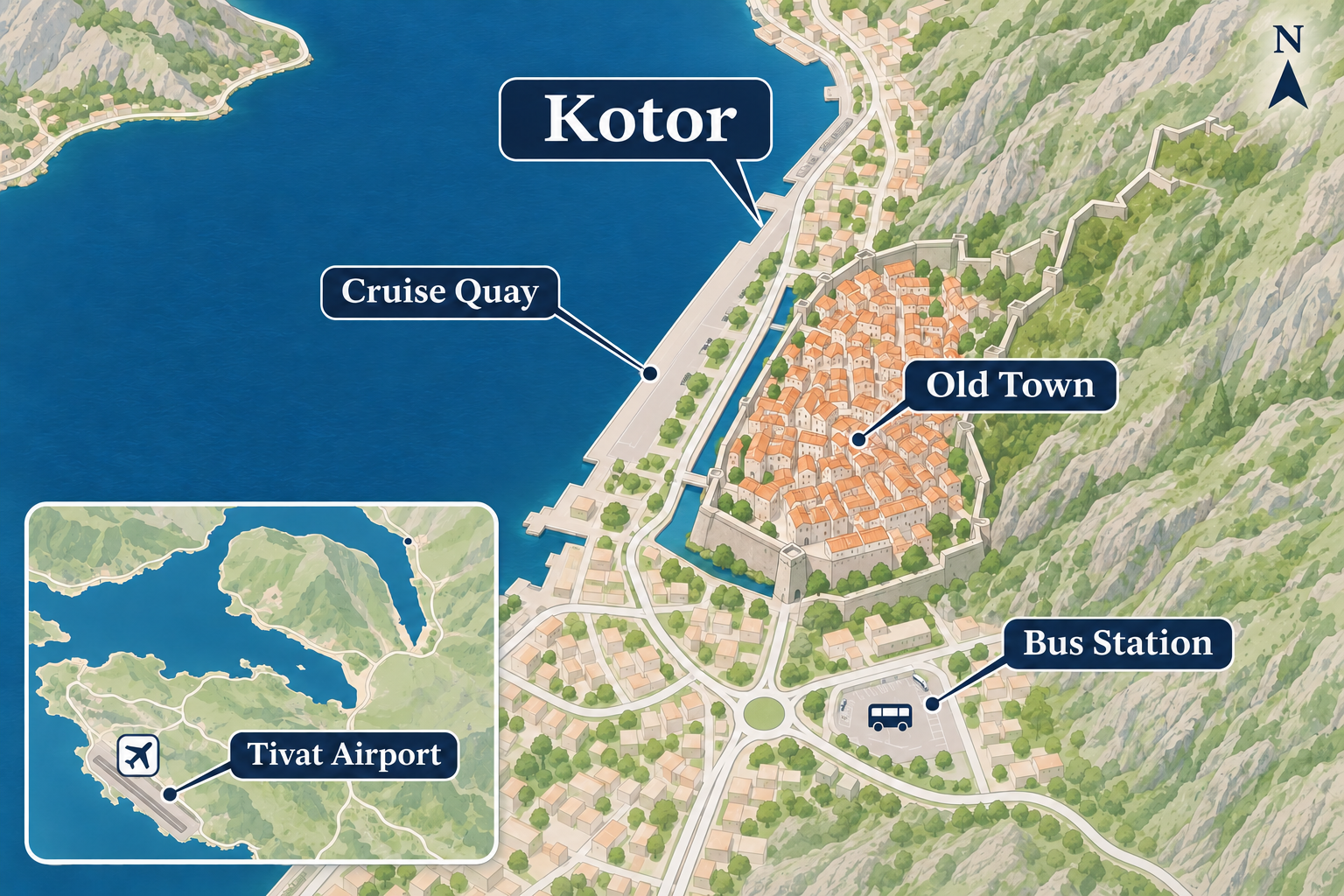
Kotor is located in Montenegro at the innermost end of the bay, between the sea, the Škurda and the hill of Sveti Ivan. The cruise port adjoins the Old Town, around 100 metres from Stari Grad. Its infrastructure includes two berths for cruise ships and three anchorage areas. Berth 1 is the main quay, while the smaller Berth 2 on the Škurda is intended for smaller vessels, megayachts and ferries. The port provides passenger transfers for ships at anchor.
Old Town and city walls
The fortifications extend up to the Fortress of San Giovanni on Sveti Ivan, which rises 260 metres above sea level. Their construction history spans the Byzantine, Nemanjić and Venetian periods. Three gates lead into the walled Old Town; the Sea Gate was renovated in the Renaissance style in 1555 and opens onto the waterfront promenade. Since 1979, UNESCO has listed the Natural and Culturo-Historical Region of Kotor as a World Heritage Site; this designation covers a precisely defined area in the inner southeastern part of the bay, including the historic towns of Kotor and Perast. In the Middle Ages, the natural harbour was a centre of trade and art. Schools of stone carving and icon painting, as well as goldsmithing and architecture, influenced communities beyond the bay along the Adriatic coast. The 1979 earthquake damaged the city walls and Romanesque churches; historic areas were subsequently restored with UNESCO involvement.
Bus station south of the Old Town
The bus station, operated by Autoboka, is located south of the Old Town and the main quay. It serves national and international bus services and has ten platforms. The address given is Ul. Put Prvoborca bb. Tivat Airport is around eight kilometres southwest of Kotor.
Maritime Museum and historical archive
Montenegro’s Maritime Museum is housed in the Baroque Grgurina Palace in the centre of the Old Town. It preserves a Venetian-influenced layout, with four rooms arranged around a central salon. The collection was first exhibited to the public in 1900 and expanded in 1938. Six bronze reliefs in the entrance area depict people and events from the 16th to the 19th century; old maps and city plans are also among the collection items. The main exhibition focuses on the maritime activities and trade of Kotor’s seafarers in the 16th to 18th centuries.
The historical archive is also part of Kotor’s cultural heritage. It preserves 182 court and notarial registers dating from the 14th to the 19th century; one series of volumes goes back to 1326, while the oldest surviving notarial deed dates from 1309. The holdings document property and legal transactions involving citizens and institutions, as well as economic and social conditions.
Kotor — Cruise Quay and Old Town
 Enlarge map ↗

