
Cruise port
Cruise to Cuxhaven
Cuxhaven at the mouth of the Elbe: the history of the Steubenhöft, from transatlantic passenger quay to port serving a variety of ship traffic.

Photo: dago
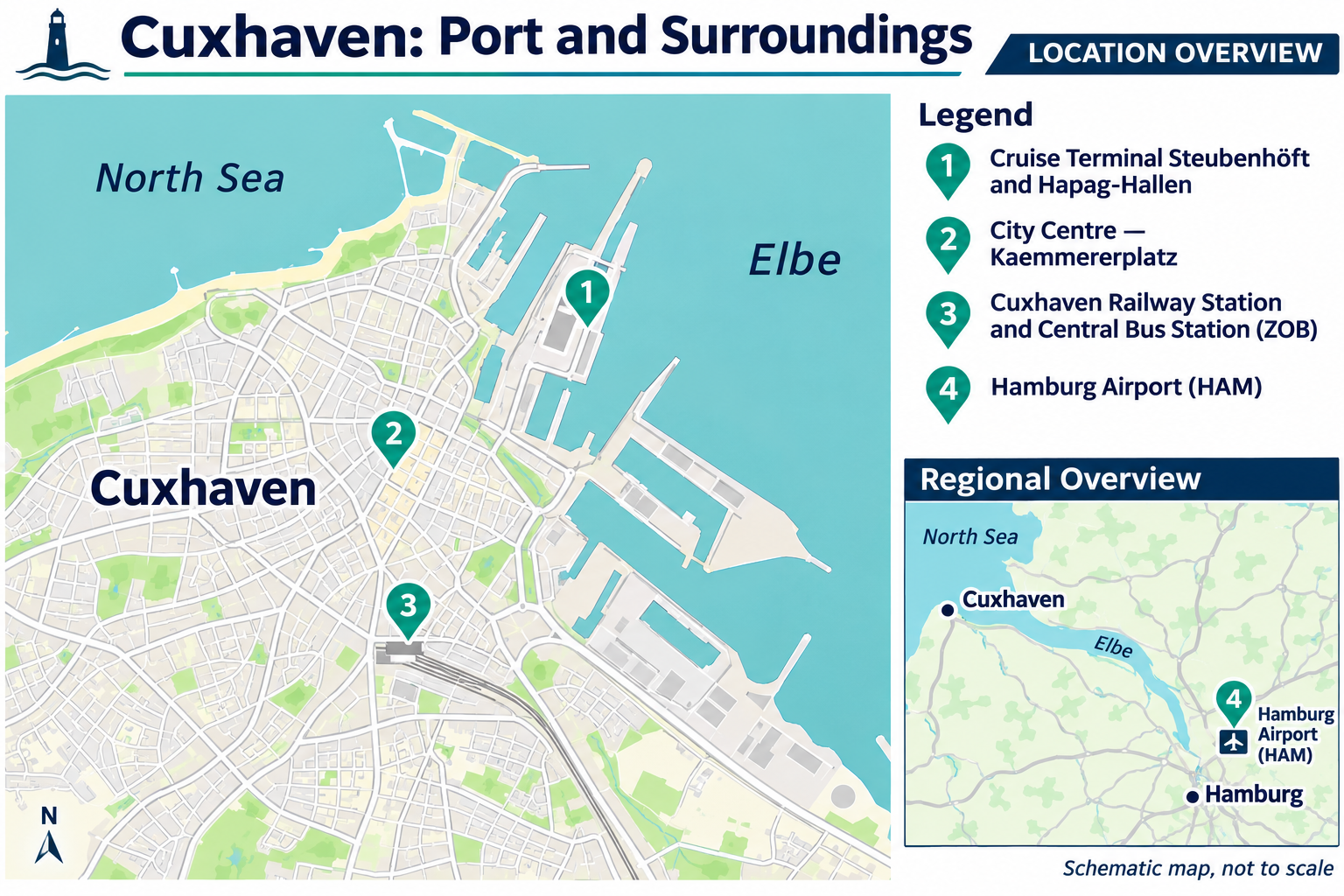
Cuxhaven lies at the mouth of the Elbe, at the point where the river meets the North Sea. For cruise passengers, the Steubenhöft is especially emblematic: the passenger quay recalls Cuxhaven’s former role in transatlantic liner services and is now used for a variety of ship traffic as well as valued for its history. A visit to the port can therefore be understood in both geographical and historical terms.
The Steubenhöft and maritime history
The Steubenhöft opened as a landing stage in 1889. In the 1890s, Cuxhaven developed into an important departure point for passenger services to North America. As the Lower Elbe upstream did not offer enough depth for increasingly large ships, the Hamburg-America Line moved the starting point of its service to Cuxhaven in 1900. From 1911, a larger landing stage was built; it was initially called “Neue Liebe” and later named after Friedrich Wilhelm von Steuben.
The Hapag Halls and the port railway station connected the quay to the hinterland: from 1902, passengers arrived directly at the complex from Hamburg on special trains. Completed in 1913, the Steubenhöft was used by the large ships of the Imperator class for voyages to New York and Boston. The “Imperator” began her maiden voyage to New York in Cuxhaven on June 11, 1913. The port was therefore not simply a landing stage, but part of a coordinated travel chain encompassing rail connections, passenger processing and the Atlantic crossing.
Passenger traffic was almost entirely suspended during the two world wars. The quay was redeveloped in the 1950s, and in 1958 the “Hanseatic” resumed the route between Cuxhaven and New York. Transatlantic liner services ended in 1972, as long-haul flights became more important to travelers. The history of the quay thus spans several eras and is not limited to today’s cruise operations.
Cuxhaven on the Elbe and North Sea
The Steubenhöft is located in the port area at the mouth of the Elbe. Here, shipping on the Elbe from Hamburg meets the gateway to the North Sea. This location was particularly important for passenger travel when large Atlantic liners began their voyages from Cuxhaven rather than Hamburg, farther upstream.
Port operations and its role today
The use of the Steubenhöft has changed over time. Local tourism information lists cruise ships, ferries and seaside resort ships among those using the facility; a historical account published in 2025 also describes cargo and container ships as the predominant traffic today. Taken together, this points to a port with changing functions rather than a terminal devoted exclusively to cruises.
The historic Steubenhöft has been a listed monument since 1979. For visitors, this offers a tangible connection to the past: the complex illustrates how Cuxhaven’s location at the mouth of the Elbe, its railway connection and the development of large passenger ships once worked together. The port’s historical significance remains clear even as the types of ships and travel options change over time.
Cuxhaven Port Map
 Enlarge map ↗

