
Cruise port
Phnom Penh: From River Port to Khmer Modernism
Phnom Penh brings together the river port on Preah Sisowath Street, the National Museum, the colonial administrative quarter and New Khmer Architecture.
River terminals on Preah Sisowath Street
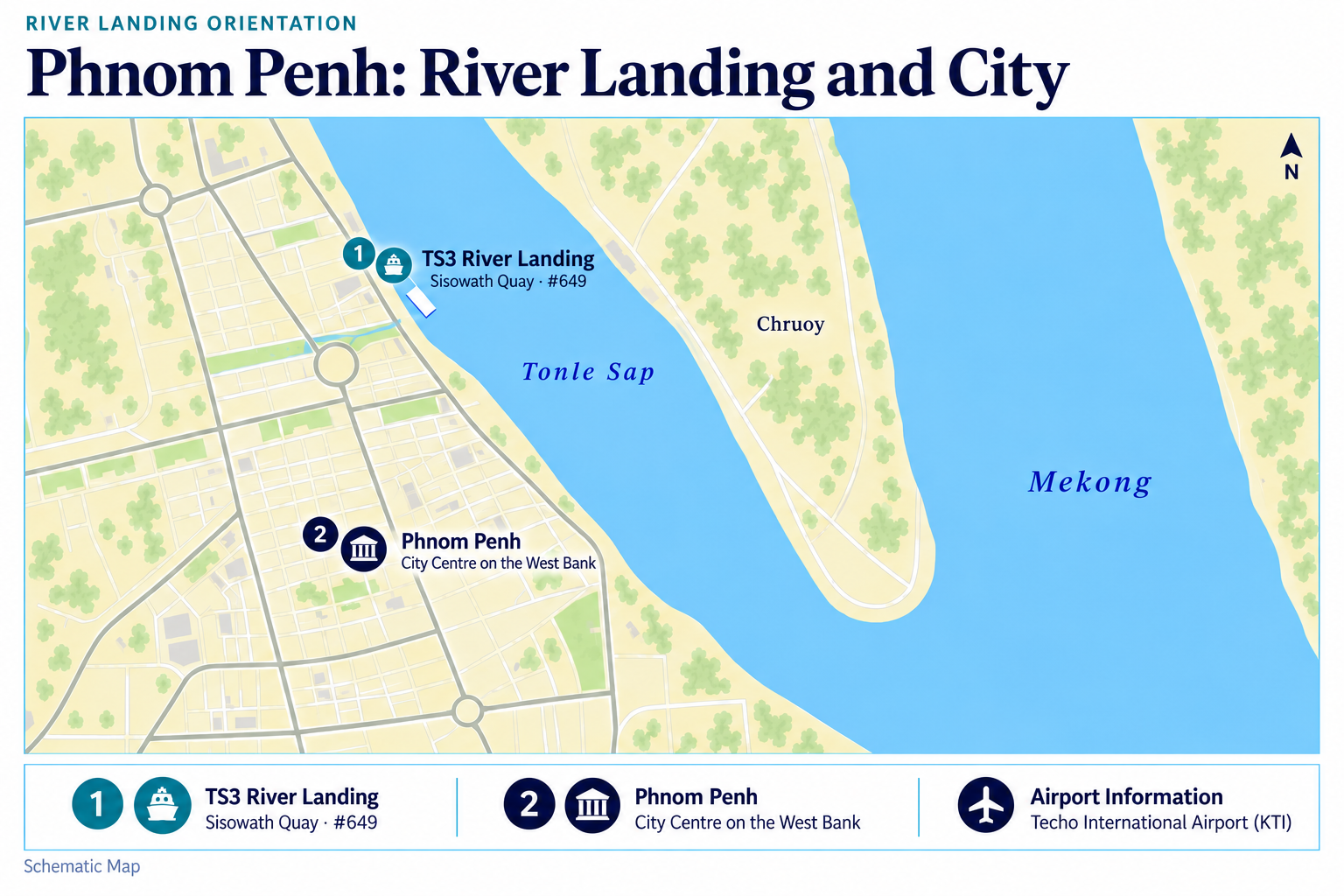
The destination of Phnom Penh lies in Cambodia, at the confluence of the upper and lower Mekong, Tonle Sap and Bassac rivers. Phnom Penh Autonomous Port operates two different port facilities on Preah Sisowath Street: the Passenger and Tourist Terminal TS1 in Wat Phnom Commune and the multipurpose TS3 terminal at number 649 in Sras Chork Commune. Both addresses are in Daun Penh District.
National Museum and Cambodian art
The National Museum was based on a design by George Groslier, who drew inspiration from Cambodian temple architecture. Its foundation stone was laid in 1917, and the museum opened on April 13, 1920, for Khmer New Year. It was closely associated with the School of Cambodian Arts, whose students, artisans and teachers preserved traditional design techniques. In 1919 it was known as the Musée du Cambodge; in 1920 it was officially renamed the Musée Albert Sarraut. Additional wings were added to the east façade in 1924. Groslier catalogued the collection; Jean Boisselier and Solange Thierry continued this work later. On August 9, 1951, responsibility for the museum and arts administration passed from the French to the Cambodian authorities. Chea Thay Seng became the first Cambodian museum director in 1966. After closing from 1975 to 1979, the museum reopened on April 13, 1979.
The colonial era and New Khmer Architecture
Phnom Penh combines French colonial architecture with the New Khmer Architecture of the 1950s and 1960s. Open balconies and shutters are features of a building style adapted to the tropical climate. In the former administrative and commercial quarter, the Central Post Office, built in 1894, stands at the center of a square. Psah Thmei, also known as the Central Market, was built in 1937 in the Art Deco style and features a large reinforced-concrete dome. On the riverfront near the Royal Palace stands Chaktomuk Hall, designed by Vann Molyvann in 1961. Its fan-shaped form combines modern architecture with a traditional Khmer tower.
The present-day Royal Palace was built under King Norodom from 1866 and officially opened on February 14, 1870. Its buildings combine French, Thai and Khmer stylistic elements; the complex underwent extensive renovation in 1962. Some wooden buildings were later rebuilt in concrete, brick and stucco, following their original designs.
Phnom Penh: River Landing and City
 Enlarge map ↗

