
Cruise port
Tulcea: Danube riverbank and local passenger landing stages
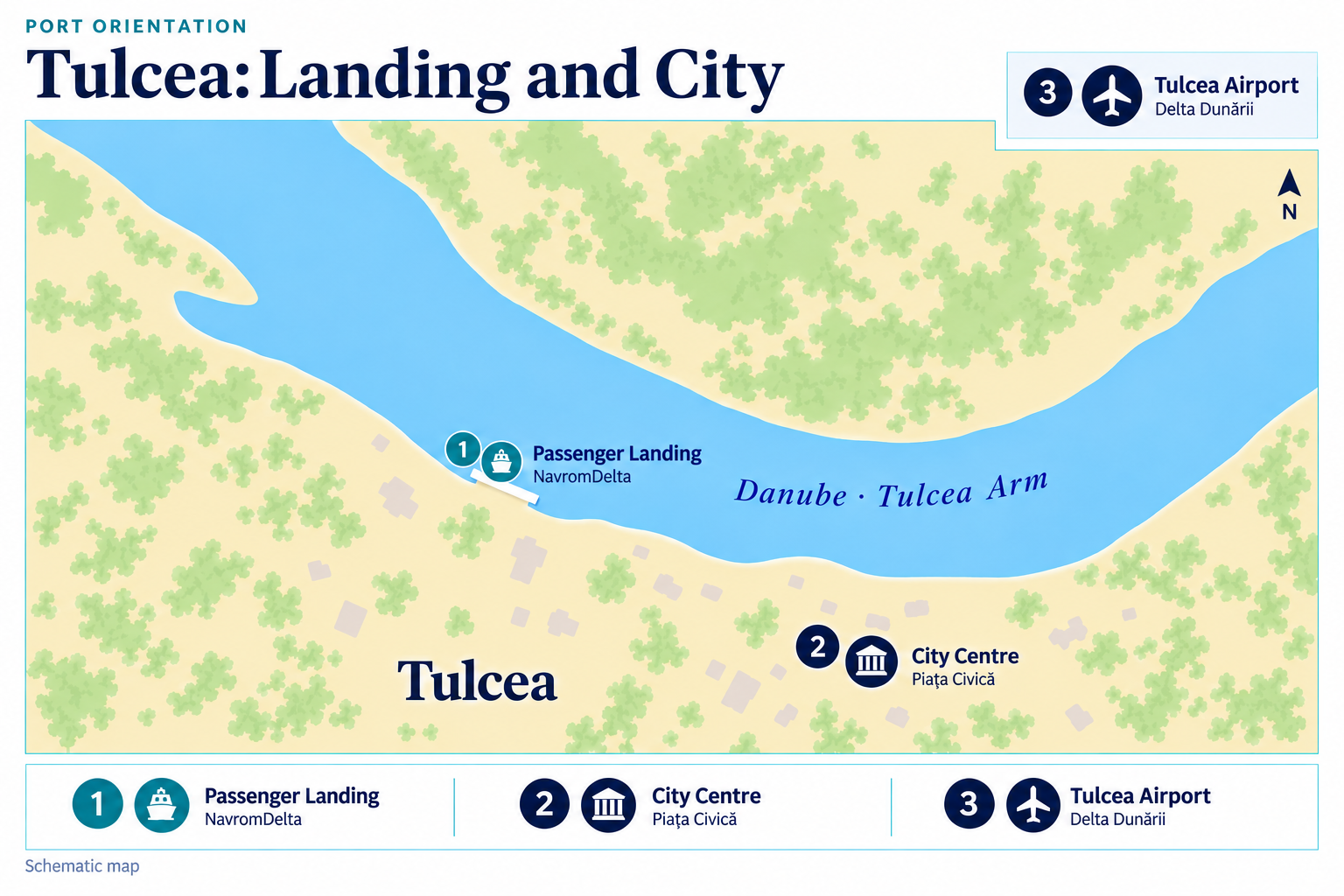
Tulcea on the Danube arm: Navrom Delta landing stages, the curve of the riverbank, Tudor Vladimirescu Peninsula, and orientation between the center and the port.
Tulcea on the Danube Arm
Tulcea lies on the southern, right bank of the Danube arm. To the north stretches the Tudor Vladimirescu Peninsula; east of the city, the water turns northeast.
Local passenger landing stages
On the western bank are the local passenger landing stages Navrom Delta 1 and Navrom Delta 2 for river cruises. Piața Civică lies inland, southeast of the western embarkation area. Farther west of the city center are Parc Ciuperca and its lake.
City history and trade
The present-day name Tulcea is recorded in Ottoman customs registers from 1506. The entry describes the place as an important center for transit trade. The settlement continued to develop in the 19th century: a shipyard was part of the local economy, and Tulcea was granted town status in 1860.
Aegyssus and the Independence Monument
The History Museum and the Independence Monument stand on the hill of the ancient settlement of Aegyssus. In Roman times, Aegyssus was a military outpost and port on the Lower Danube frontier. Archaeological remains include a bath complex, used from the late first century and remodeled several times until the beginning of the fifth century. During one phase of reconstruction, a large palaestra—a space for physical exercise—was added to the north.
The Independence Monument combines an obelisk with figures of an eagle and a soldier. Construction began on October 17, 1879, in the presence of Prince Carol I. It commemorates the War of Independence, which brought Dobruja into Romania.
Amphorae from the first century BC and the first century AD are among the archaeological finds from Aegyssus and point to trade at the time. After Trajan’s Dacian Wars, the settlement was incorporated into the Lower Danube frontier system at the beginning of the second century. A unit of the Roman Danube fleet, Classis Flavia Moesica, maintained an outpost here.
The delta and transport history
The city lies at the gateway to the travel region of the Danube Delta, a landscape shaped by waterways, lakes and marshes. UNESCO added the delta to its World Heritage List in 1991. More than 300 bird species and 45 freshwater fish species live in this natural area.
Between 1970 and 1972, the railway, river transport and road transport stations were all located at the same site.
Tulcea: Landing and City
 Enlarge map ↗

