
Cruise port
Lutherstadt Wittenberg on the Elbe: Landing Places and Old Town
Passenger landing on the Elbe, how to get there, and the history of the Reformation in Lutherstadt Wittenberg.
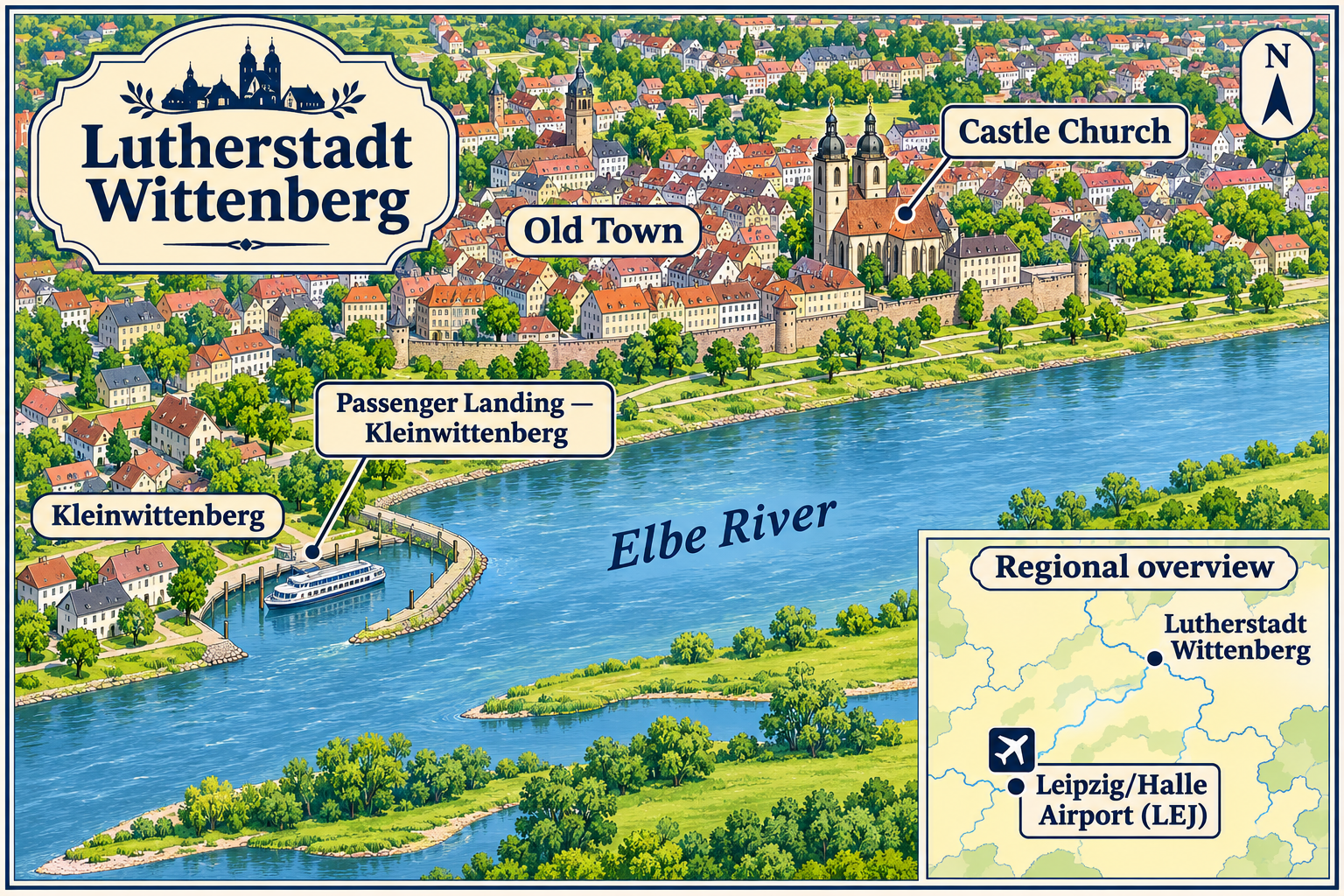
Lutherstadt Wittenberg lies on the Elbe and has two berths for passenger vessels in its protected harbor. The waterway kilometering records a passenger-ship landing and water police station on the right bank at Elbe km 216.6. The municipal industrial harbor and the Marina-Camp Elbe marina for pleasure boats are separate facilities.
Elbe stop and getting there
Wittenberg can be reached via the main railway station and the separate Lutherstadt Wittenberg Altstadt stop; buses connect the station with the city. The main railway station is at Am Hauptbahnhof 1.
Residence and Reformation
The Residence Palace and the Castle Church, consecrated in 1503, are among Wittenberg’s central Reformation sites. According to tradition, Martin Luther nailed his 95 Theses to its door; Luther and Philipp Melanchthon are buried in the church. Today, the palace houses, among other things, the Research Library for the History of the Reformation and serves as the visitor entrance to the Castle Church. St. Mary’s Church, Wittenberg’s oldest building, is also a UNESCO World Heritage Site; Luther preached there.
The Melanchthon House at Collegienstraße 60 was Philipp Melanchthon’s home and workplace. The Renaissance house has been part of the UNESCO World Heritage Site since 1996; its exhibition uses works, manuscripts and paintings to present the humanist’s life and work.
The Cranach Courtyards at the Market Square and on Schlossstraße were places where the painter family worked. Lucas Cranach the Elder was appointed court painter in Wittenberg in 1505 and lived in the city for almost half a century. The exhibition “Cranach’s World” offers insights into the family and includes ceiling paintings, among other things. Today, alongside historic traces, the courtyards are home to artists’ studios, cafés, a print shop and a youth art school.
The Luther Garden is also part of the cityscape: the Lutheran World Federation established it with 500 trees as a symbol of ecumenism. The “Heavenly Cross” installation forms its centre, with seven paths leading from it out into the world. In this way, Wittenberg connects its Elbe stop with a rich core of Reformation and art history, explored through several historic sites.
The cruise ports in Germany place Wittenberg among the country’s river and coastal destinations. The port directory lists other embarkation and shore-excursion destinations; the overview of cruise destinations and sailing areas shows the broader route network.
Lutherstadt Wittenberg River Port Map
 Enlarge map ↗

