
Destinations | Cruise ships | Ports for your cruise | Cruise lines | Cruise Tips | Cruise Photos | Cruise News
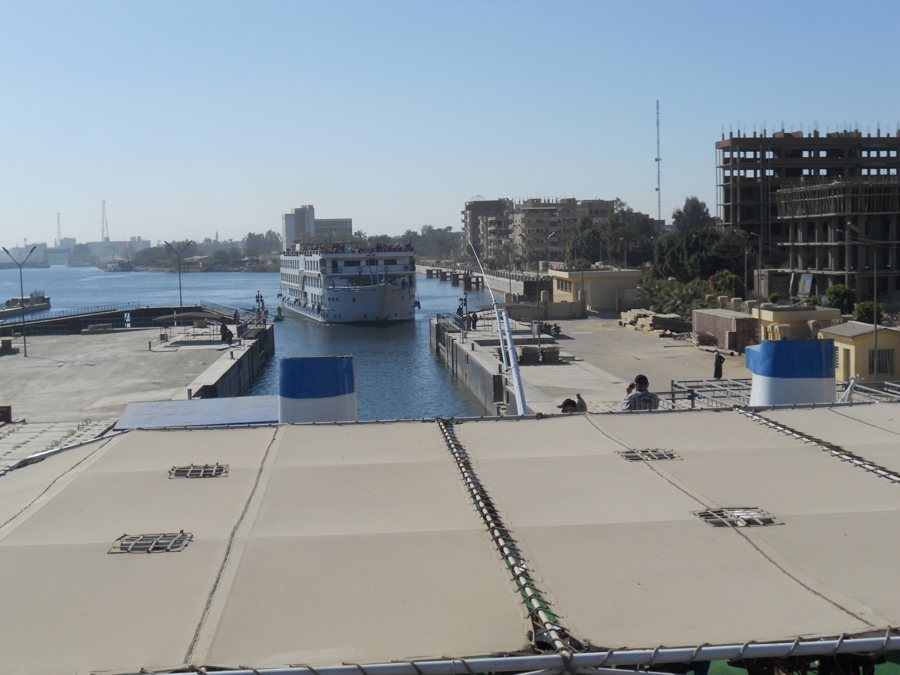
Locks on cruise routes: changes in elevation, waiting times and route-specific factors
Water levels can differ between sections of rivers and canals. A lock overcomes this difference in elevation by raising or lowering a vessel in a chamber to the water level of the next section. On a route with several level changes, a vessel passes through several locks accordingly. The facilities and their operating conditions vary from one waterway to another, so the duration and process cannot be stated generally for an entire cruise. The terms navigable channel and navigation channel are useful for understanding the location of the area being navigated.
How a lock compensates for a difference in elevation
A lock chamber is closed at both ends by gates. To travel upstream, water is let into the chamber; to travel downstream, water is drained from it. The vessel moves with the rising or falling water in the chamber; it is not mechanically lifted like a platform lift. Once the water levels in the chamber and the next section have been equalized, the appropriate gate opens and the vessel can continue.
The number of locks on a journey depends on the waterway chosen and the changes in elevation along it. A single lock can overcome a considerable difference in elevation; elsewhere, several locks may be located one after another. That is why the number of locks alone says little about the total travel time. The sequence along the route also matters: a vessel must pass through each facility in the intended direction and fit into the local operating process.
Why waiting times vary
The time spent in the lock itself is only part of the total time. The approach, instructions and, where necessary, waiting for a chamber to become available also add to it. How long this takes depends, among other things, on the time of arrival, traffic, operating hours and whether several compatible vessels can be locked through together. Restrictions, repairs or a temporary closure can also affect the process.
Local water conditions can also play a role. In 2026, a notice from the Federal Waterways and Shipping Administration reported waiting times of up to two hours for recreational craft on the Elbe-Lübeck Canal because of water shortages. This is a time-specific notice concerning a particular type of vessel, not a general estimate for river cruise ships. A gauge reading is not equivalent to the available depth at every point along a route; water level and water depth are different measurements.
ELWIS publishes lock operating hours and contact details for federal inland waterways. Exceptions to regular hours, for example because of repairs, are published in the inland navigation notices, which also show current and anticipated closures. For a cruise, these notices are only a snapshot. The actual course of the journey also depends on the route, the vessel’s scheduling and the conditions on site.
The locks a vessel passes through, and the number of changes in elevation it must negotiate, therefore depend on the specific itinerary. Information about one location cannot be applied to a different waterway or to the entire route. An assessment of water levels and seasonal navigability on river cruises takes into account that conditions vary from one section to another. When assessing a journey, locks are part of the route and can interrupt the voyage; no general additional time can be inferred from this alone.
Photo: Angelika + Peter Baczkowski
